Why warm neutrals are replacing gray in homes
Khaki, cream and brown took over the 2026 paint colour of the year picks, and wood cabinets passed white. Here is what's rising, what's fading, who warm neutrals suit and what switching costs.
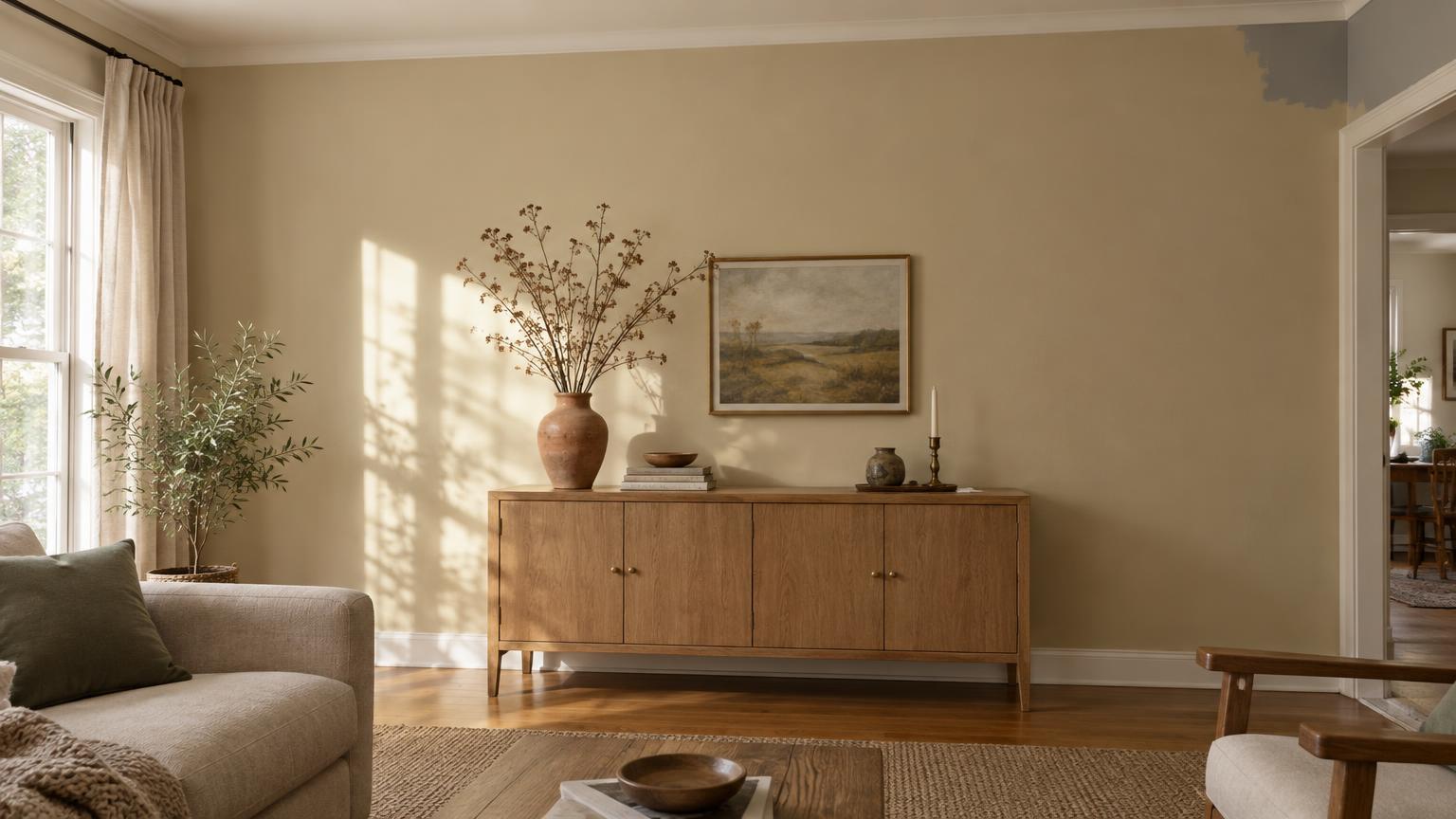
The cool, blue-leaning grays that covered walls and cabinets through the 2010s are giving way to warm neutrals: khaki, tan, cream, warm greige and deep brown. The evidence is in what the big paint brands chose as their 2026 colour of the year and in what homeowners are actually putting in their kitchens. For 2027 the brands have moved on to green, but they picked earthy, warm greens designed to sit with those same tans and browns. If you are repainting soon, a warm neutral is a sensible choice that should still look current in a few years. Cool gray is the one that's fading.
What the paint brands picked for 2026
Treat a colour of the year as a forecast and a sales push rather than proof of what people buy. Even so, the 2026 picks lined up closely:
- Sherwin-Williams and HGTV Home by Sherwin-Williams chose Universal Khaki (SW 6150), a mid-tone warm neutral with a slight yellow cast. The brand filed it under a palette it calls Foundational Neutrals.
- Benjamin Moore chose Silhouette (AF-655). Its October 2025 announcement describes it as rich espresso with subtle notes of charcoal, and Andrea Magno, who leads colour marketing there, pointed to "the growing interest in the brown color family."
- Glidden went darker and redder with Warm Mahogany.
Behr (Hidden Gem, a smoky jade) and Valspar (Warm Eucalyptus, a soft green) went another way, and their picks hinted at what came next.
Where it goes in 2027
The 2027 announcements, made between August and October 2026, turned green. Behr named Grounded (T27-01), an olive-moss shade its August 2026 release says has "subtle brown undertones," backed by a palette of warm neutrals. Sherwin-Williams named Celery (SW 6421) on 15 September 2026, a soft yellow-green that, as Hunker reported, blends khaki, butter yellow and sage. Benjamin Moore followed with Webster Green (HC-130), a deep green between emerald and evergreen, and surrounded it with Shakespeare Tan, Townsend Harbor Brown and Antique Copper.
So the headline colour moved, and the base it sits on stayed warm. Brands are pairing these greens with tans, wood and brown, not with silver-gray. For a homeowner, that's the useful part: a khaki or cream wall painted now works as the backdrop for whatever accent colour comes next.
The kitchen numbers tell the same story
Paint announcements are opinions. Remodelling surveys show what people spent money on. The 2026 Houzz Kitchen Trends Study, which surveyed more than 1,700 homeowners about their latest kitchen remodel and was summarised by the National Association of Realtors, found:
- Wood cabinets at 29%, up six points, now just ahead of white at 28%, down five.
- Off-white cabinets at 15%.
- Among coloured cabinets, green at 6% has passed gray at 5%.
- Wood island countertops at 39%, up 12 points.
Wood is warm by nature, and once the cabinets are oak or walnut, a cool gray wall beside them tends to look flat and a little blue. That's a big part of why warm wall colours are following the cabinets.
Is it rising, peaking or fading?
Here is where each piece stands as of late 2026, based on the announcements and survey above:
| Trend | Status | Why |
|---|---|---|
| Cool blue-gray walls and cabinets | Fading | Gray cabinets down to 5% in the Houzz study; no major brand picked a cool gray for 2026 or 2027 |
| Khaki, tan, cream and warm greige | Peaked as a headline, staying as a base | Named for 2026, then used as the companion palette for 2027's greens |
| Deep browns (espresso, mahogany) | Peaking | Two of the big 2026 picks; best in small doses or rooms that already feel cosy |
| Earthy greens with warm undertones | Rising | Behr, Sherwin-Williams and Benjamin Moore all chose greens for 2027 |
None of this means your gray walls are suddenly wrong. If they suit your floors and light, there's no reason to repaint just for a trend.
Who warm neutrals suit
They suit homes with wood floors, oak or cherry trim, brass or bronze hardware, and terracotta or beige tile, because they pick up the warmth already in the room. They also help rooms that face north, where the light is cooler and can make gray look cold and murky.
They are a harder fit if your fixed finishes are cool. Gray porcelain floor tile, blue-gray quartz or gray vinyl plank can look dingy next to a yellow-leaning khaki. In those rooms, look for a greige that sits between the two, or keep the gray and warm the room with wood, textiles and lighting instead.
Renters should check the lease first. Many landlords allow painting only if you repaint the original colour when you leave, which doubles the cost.
How to tell a warm neutral from a cool one
Hold the paint chip against a sheet of plain white printer paper. A warm neutral shows a hint of yellow, red or orange next to the white. A cool gray shows blue, green or violet. Then tape a large sample (or a painted sheet of card) to two walls and look at it in the morning, at midday and under your evening lamps. Undertones shift a lot with light, and warm bulbs push everything warmer still.
What it costs to switch
Prices vary by brand, region and how much prep your walls need, so treat these as rough ranges. NerdWallet's cost guide puts interior paint at about $15 to $60 or more per gallon and primer at $20 to $60, and cites Lowe's estimate that a gallon covers 350 to 400 square feet. It puts professional interior painting at about $2 to $6 per square foot.
For one average bedroom done yourself, that usually means two gallons of paint for two coats, plus rollers, brushes, tape and drop cloths if you don't already own them. To work out your own quantity, our step-by-step guide to how much paint you need for a room walks through the measuring.
If you repaint a room yourself
- Time: a weekend for a typical bedroom, including drying time between coats.
- Skill: beginner.
- Materials: paint (two coats), primer if you are covering a dark colour, roller frame and 3/8-inch nap covers, an angled 2- to 2.5-inch brush, tray, painter's tape, drop cloths, spackle and a sanding sponge.
Fill nail holes and dents before you paint, and spot-prime the patches so they don't show through as dull spots. Our guide to patching holes in drywall covers everything from nail pops to larger holes. Open windows or run a fan while you work, and set the stepladder on a level floor, never on a bed or chair.
If your home was built before 1978, the old paint may contain lead. Don't sand or scrape it until it has been tested; the EPA lists certified lead-safe renovators if the test comes back positive.
