How much paint you need for a room, worked out step by step
Measure the walls, subtract doors and windows, multiply by coats and divide by the can's coverage. A worked bedroom example shows the arithmetic for walls, ceiling, trim and primer.
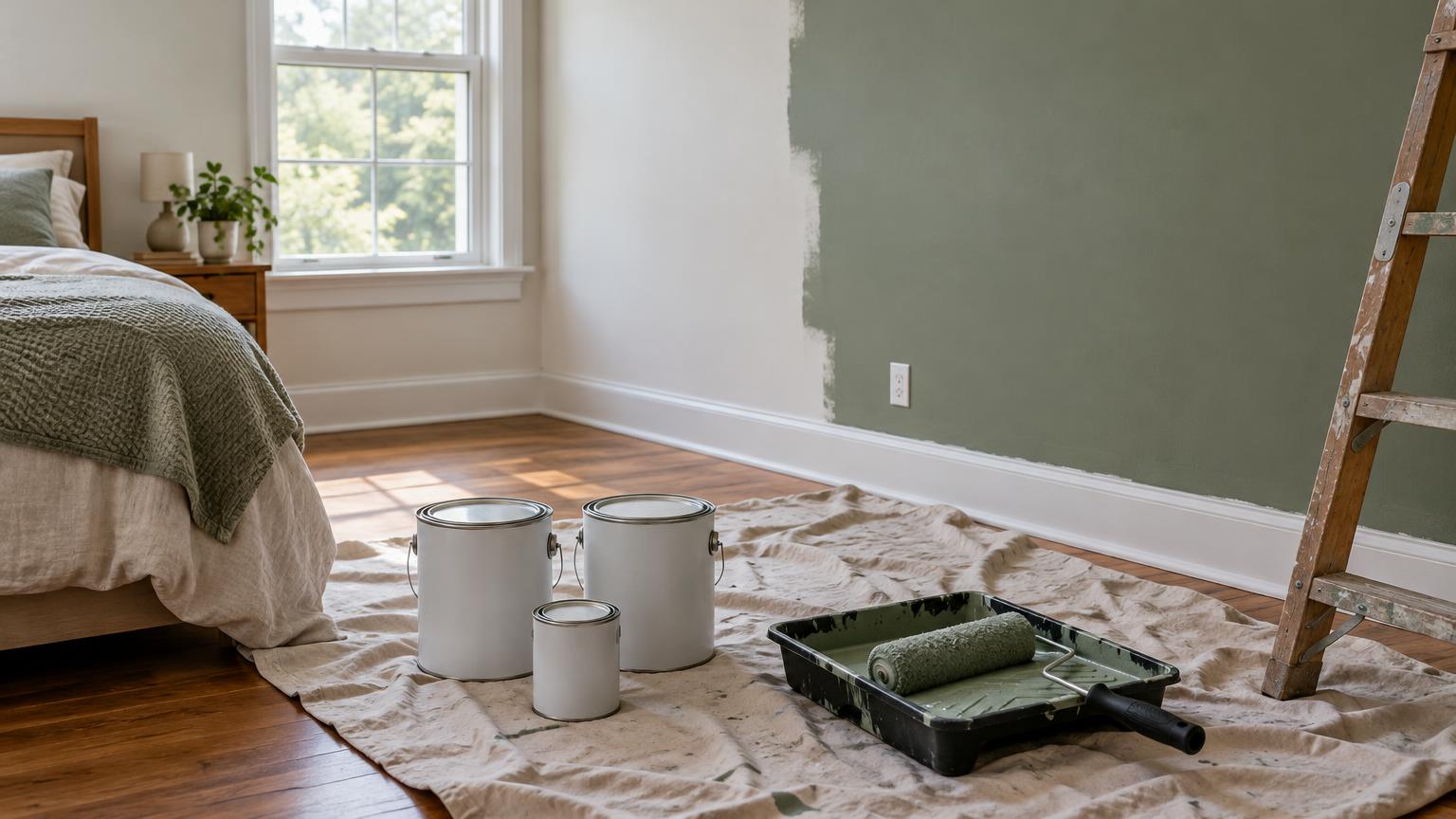
To work out how much paint a room needs, measure the wall area, subtract the doors and windows, multiply by the number of coats, and divide by the coverage printed on the can. Most interior wall paints cover about 350 to 400 square feet per gallon, the range Sherwin-Williams gives in its paint calculator. A typical 12 by 14 foot bedroom with 8-foot ceilings needs about 2 gallons for two coats on the walls, one more gallon for the ceiling, and a quart for the trim. The full arithmetic is below, so you can swap in your own room.
What you need to measure
The measuring takes about 15 minutes for one room, and it is a beginner job.
- Tape measure (a 25-foot one reaches across most rooms)
- Notepad or phone for the numbers
- Calculator
- A step stool if you cannot reach the top of the wall to check the ceiling height
Read the coverage line on the can or the product page before you start. It varies between brands and product lines, and it is the number to use in place of the 350 to 400 rule of thumb.
Step 1: Find the gross wall area
Add up the length of every wall to get the room's perimeter, then multiply by the wall height. A 12 by 14 foot room has a perimeter of 12 + 14 + 12 + 14 = 52 feet. With 8-foot walls, that is 52 x 8 = 416 square feet.
For an L-shaped room or one with a bay, measure each wall on its own and add them up. A sloped ceiling makes triangles: half the base times the height for each one.
Step 2: Subtract doors and windows
Measure each opening's width and height, multiply, and subtract the total from the gross wall area. If you would rather estimate, Behr's interior paint guide uses about 20 square feet for a door and about 15 for a window, and This Old House uses 20 for a door and 10 for a window. Windows vary a lot, so measuring yours beats either average.
Skip this step for closet doors you plan to paint along with the walls, and for small openings such as vents.
Step 3: Decide how many coats
Two coats is the usual plan for walls, and This Old House works its estimates on that basis. One coat can be enough when you are repainting the same colour over itself or a clean white over white, with a good paint and a wall in good shape.
Count on two full coats, and sometimes a primer coat too, when:
- you are making a big colour change, light over dark or dark over light
- the wall is bare drywall, a fresh skim coat or a patch (porous surfaces soak up more paint)
- the old paint is glossy, stained or patchy
If you are switching a cool grey for a warm neutral of similar lightness, two coats of topcoat usually do it. Our piece on why warm neutrals are replacing gray covers which shades suit which rooms.
Step 4: Divide by the coverage and round up
Multiply the net wall area by the number of coats and divide by the coverage on the can. Round up to the next quart or gallon. A quart is a quarter of a gallon and covers about 100 square feet, by This Old House's figures.
Running the numbers at both ends of the 350 to 400 range shows how much the can's stated coverage matters. If the result lands just over a whole gallon, a quart on top is usually cheaper than a second full gallon.
A worked example: one bedroom
Here is the 12 by 14 foot room from Step 1, with 8-foot walls, one standard 3 by 6 foot 8 inch door (20 square feet) and two 3 by 5 foot windows. It gets two coats on the walls and ceiling and two coats of semi-gloss on the trim.
| Item | Measurement | Arithmetic | Result |
|---|---|---|---|
| Perimeter | Four walls | 12 + 14 + 12 + 14 | 52 ft |
| Gross wall area | Perimeter x height | 52 x 8 | 416 sq ft |
| Door | 3 ft x 6.67 ft | 3 x 6.67 | 20 sq ft |
| Windows | Two at 3 ft x 5 ft | 2 x (3 x 5) | 30 sq ft |
| Net wall area | Gross minus openings | 416 - 20 - 30 | 366 sq ft |
| Wall paint, two coats | Net area x 2 | 366 x 2 | 732 sq ft |
| Gallons at 400 sq ft/gal | Area / coverage | 732 / 400 | 1.83 gal |
| Gallons at 350 sq ft/gal | Area / coverage | 732 / 350 | 2.09 gal |
| Ceiling area | Length x width | 12 x 14 | 168 sq ft |
| Ceiling paint, two coats | Area x 2 / 400 | 336 / 400 | 0.84 gal |
| Baseboard | Perimeter minus door, 4 in tall | (52 - 3) x 0.33 | 16.2 sq ft |
| Door and window casing | About 48 ft of 3 in casing | 48 x 0.25 | 12 sq ft |
| Trim paint, two coats | Trim area x 2 / 400 | 28.2 x 2 / 400 | 0.14 gal |
| Primer, if needed | Net wall area / 300 | 366 / 300 | 1.22 gal |
So the shopping list for this room is:
- Walls: 2 gallons if the can says 400 square feet per gallon. If it says 350, buy 2 gallons and a quart.
- Ceiling: 1 gallon of ceiling paint.
- Trim: 1 quart of trim paint, with plenty left over.
- Primer (only if needed): 1 gallon and 1 quart, or 2 gallons if your store sells primer only by the gallon.
The primer line uses 300 square feet per gallon because primer covers less than paint. Sherwin-Williams and This Old House both put it at about 200 to 300 square feet per gallon, so check the can and buy toward the high side if the wall is new drywall.
Ceilings and trim
Ceilings are simple: length times width. Flat ceiling paint is the usual choice because it hides roller marks and small dents. A ceiling that is already white and in good shape may need only one coat; a water stain needs a stain-blocking primer first, or it will bleed through.
Trim is measured in length, not area. Add up the baseboard, door casing and window casing in feet, multiply each run by its height in feet (a 4-inch baseboard is 0.33 feet, a 3-inch casing is 0.25), and add the results. A typical room's trim comes to well under 100 square feet, so a quart usually covers two coats. Doors are the exception: a flat six-panel door is about 20 square feet per side, so painting both sides of several doors can need a full gallon.
Buy a little extra for touch-ups
Keep some paint back after the job. Scuffs, nail holes and the patch from a door handle all need the exact colour later, and a custom tint mixed months apart may not match. This Old House suggests buying one or two extra quarts for touch-ups and buying all of a custom colour at the same time. In the example above, 2 gallons at 400 square feet per gallon leave about 68 square feet over, less than a quart, so add a quart if you want a real reserve.
Label the lid with the room, colour name, sheen and date, and store the can somewhere that does not freeze.
Before you open the can
Patch holes and cracks first, and give the patches time to dry before priming them; our guide to patching a hole in drywall walks through nail pops up to fist-sized holes. Shut off the power at the breaker before removing outlet and switch covers, and keep the room ventilated while you paint.
If your home was built before 1978, the old paint may contain lead. Do not sand or scrape it until it has been tested. If the test is positive, hire a contractor certified under the EPA's lead-safe renovation rules for the prep work.
