Drill or impact driver: which one to buy first
A drill/driver is the first tool most homes need; an impact driver earns its place on decks, fences and long screws. How each works, what they cost, and which battery platform to pick.
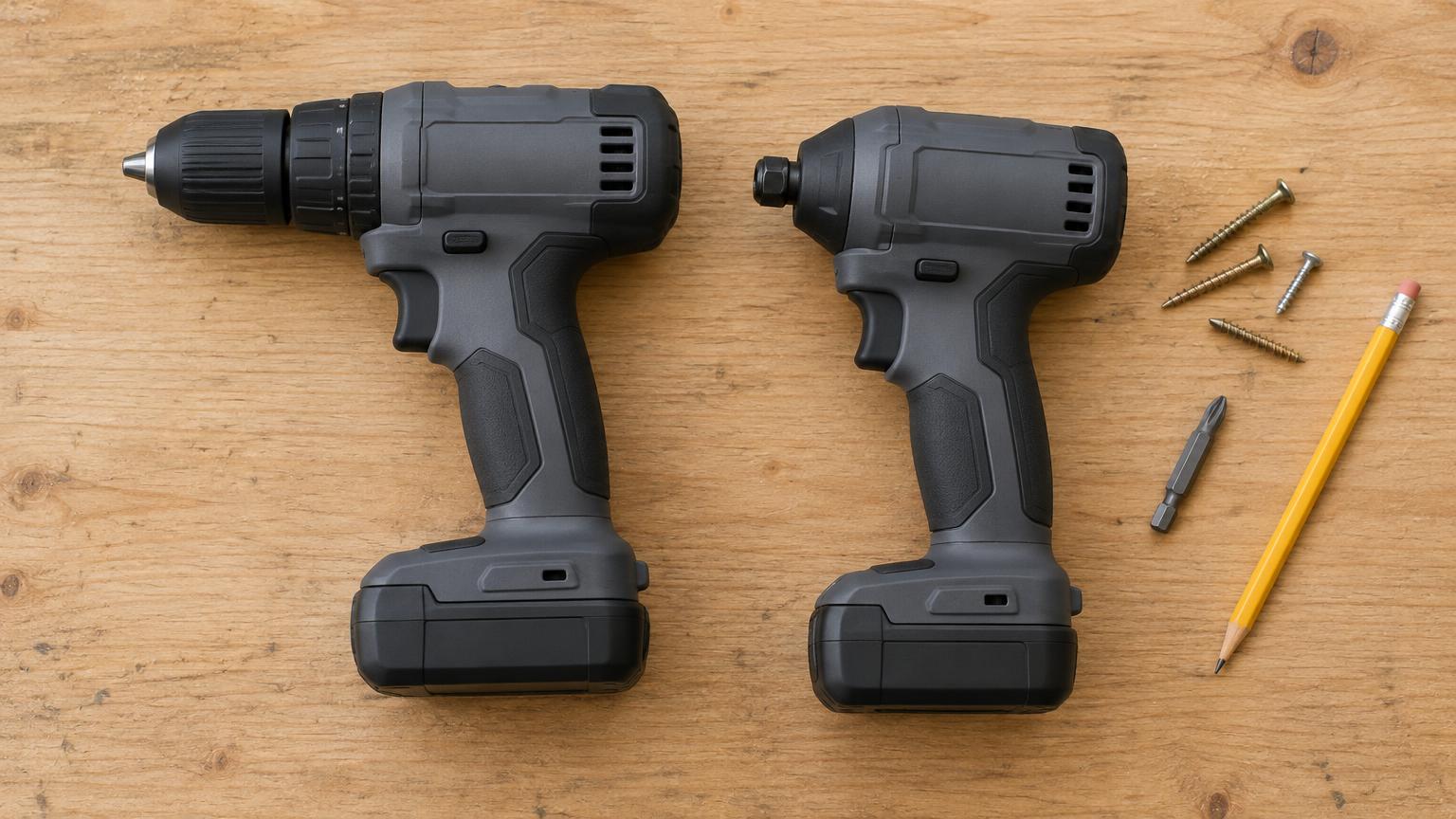
Buy a drill first. A drill/driver makes clean holes in wood, metal, drywall and (with a masonry bit) brick, and its clutch lets it drive screws without stripping them or sinking them too deep. An impact driver is a specialist: it drives long screws and lag bolts far more easily than a drill can, but it is a poor tool for drilling holes and is too rough for small, delicate screws. If you already own a drill and you are about to build a deck, a fence or a run of shelving, an impact driver is the second tool worth buying, and a kit that bundles both often costs only a little more than the drill alone.
What a drill does
A drill/driver spins its bit with steady, continuous turning force from the motor and gearbox. Two parts set it apart.
The chuck is the adjustable collar at the front. Its three jaws close as you twist it, so it grips round drill bits, hex-shank bits, hole saws and paint mixers alike. Most cordless drills sold for home use have a 1/2-inch keyless chuck, which means it opens to hold shanks up to half an inch thick and tightens by hand.
The clutch is the numbered ring just behind the chuck. Set it to a low number and the drill slips (you hear a ratcheting click) once a screw meets that much resistance, so the screw stops flush instead of tearing through drywall or splitting a cabinet face. Higher numbers allow more torque, and the drill-bit symbol on the ring turns the clutch off for drilling. Most drills also have a two-speed gearbox: low gear for driving screws and large bits, high gear for small holes.
What an impact driver does
An impact driver looks like a stubby drill, but the business end works differently.
Instead of a chuck it has a 1/4-inch quick-release hex collet. You pull the collar forward, drop in a bit with a 1/4-inch hex shank, and let go; it springs back and locks. That is fast, but it means only hex-shank bits fit.
Inside is a hammer and anvil. The driver turns the bit smoothly until the screw resists, then the hammer slips past the anvil, spins up and strikes it, many times a second. Pro Tradecraft's guide to impact drivers puts some models at more than 4,000 impacts per minute. Those rotational blows push a 3-inch deck screw into framing lumber without the tool twisting your wrist, because the force is delivered in bursts rather than as one long shove. The same mechanism makes impact drivers loud, so wear hearing protection for long sessions.
For a sense of scale, DeWalt's compact DCF840 impact driver is listed by retailers at 1,700 in-lbs of maximum torque and about 5.1 inches long. That is a lot of twisting force from a tool shorter than most drills, packed into a body that weighs about 2 pounds bare.
There is no clutch. Many impact drivers offer speed modes instead, and on most of them low speed also means low force, but none stops at a set torque the way a drill does. That is the reason to keep it away from cabinet hinges, electrical cover plates and anything assembled with small screws.
Which jobs suit each tool
| Job | Better tool | Why |
|---|---|---|
| Drilling pilot holes and clearance holes | Drill | Round bits, steady speed, accurate start |
| Drilling large holes with a spade bit or hole saw | Drill | Chuck grips round shanks; smooth torque |
| Hanging shelves, curtain rods, TV mounts into studs | Either | Drill for the holes, impact for long screws |
| Assembling flat-pack furniture, cabinet hardware | Drill (low clutch) | Clutch stops before screws strip |
| Deck boards, fence pickets, framing screws | Impact driver | Drives long screws all day without wrist strain |
| Lag bolts for a ledger or pergola | Impact driver | Bursts of torque without kickback |
| Mixing paint or thinset | Drill | Needs a chuck and steady, slow speed |
| Driving screws into masonry anchors | Either | Drill the hole first with a masonry bit |
Patching a large hole in drywall is a good example of a job where a drill alone is enough: the step-by-step drywall patch guide uses a few drywall screws to fix backing strips behind the hole, and the clutch keeps each screw head just under the paper face.
You can drill with an impact driver using hex-shank bits, and Pro Tradecraft notes it works for spade and step bits. It vibrates more and starts holes less precisely, so treat it as a backup, not a replacement.
What they cost
Prices change weekly with sales, so treat these as ranges seen at major US retailers in 2026 and check the current price before you buy.
Bare tools come without a battery or charger. A budget impact driver such as Ryobi's ONE+ PCL235B lists at about $59 at Home Depot. Milwaukee's M18 2606-20 drill/driver has shown up from about $72 on sale to about $139. Pro-grade brushless models cost more: Milwaukee's M18 FUEL 2804-20 drill/driver lists around $189 at a supplier, and DeWalt compact brushless drills run about $140 to $150 as bare tools.
Two-tool kits bundle a drill, an impact driver, two batteries and a charger. Ryobi has sold its ONE+ drill and impact kit with two 1.5Ah batteries for $99, against a $139 list price. DeWalt's brushless DCK227D2 kit lists at $249 and went for $149 to $169 on sale at Lowe's this year.
For larger kits, Ryobi's six-tool ONE+ combo with two batteries sold for $199 to $234 on sale in 2026, against list prices of $299 and up.
The pattern is consistent: the battery and charger are the expensive part, so a two-tool kit is usually the cheapest way to own both tools, and bare tools only make sense once you have batteries.
Battery platforms matter more than the tool
Each brand's batteries fit only that brand's tools (and sometimes only one voltage line within the brand). Pick a platform and you will likely stay on it for years, because every later tool is cheaper bought bare.
- Ryobi ONE+ (18V): Ryobi says every 18V ONE+ battery works in every ONE+ tool, past and future, a promise dating from the platform's 1996 launch. Its support site lists over 225 ONE+ products, including garden and cleaning tools. Its 40V and USB lithium lines are separate systems.
- DeWalt 20V MAX: the "20V MAX" figure is the voltage of a fully charged pack with no load; DeWalt's fine print gives the nominal voltage as 18V, the same as other 18V tools, as Pro Tool Reviews explains. It is a common pro and serious-DIY choice with a wide tool range.
- Milwaukee M18: another large professional line, priced near DeWalt, with a separate M12 platform for compact tools.
A 12V platform (Milwaukee M12, DeWalt 12V MAX, Bosch 12V) gives lighter, smaller tools that are pleasant for furniture and cabinet work but slower on decks and framing.
Look at the third and fourth tools you expect to want (a circular saw, a leaf blower, a shop vac) and choose the platform that sells them at a price you will pay.
Who should buy which first
- Renters and first-time owners hanging pictures, assembling furniture and fitting curtain rods: a drill/driver, ideally in a two-tool kit if the price gap is small.
- Anyone planning a deck, fence, shed or garage shelving: buy the two-tool kit. You will drill pilot holes with the drill and drive every long screw with the impact driver, without swapping bits back and forth.
- People who already own a drill: add an impact driver as a bare tool on the same battery platform.
- Mostly small-screw work (cabinets, electronics, toys): a 12V drill/driver, and skip the impact driver for now.
Using them safely
Wear safety glasses whenever you drill; chips and broken bits fly toward your face. Clamp small workpieces rather than holding them. Before drilling into a wall, check for pipes and cables with a stud finder that detects live wiring, and avoid drilling straight above or below outlets and switches, where cables usually run vertically. Remove the battery before changing bits or clearing a jammed one. If a job means opening an electrical box or running new circuits, stop there and call a licensed electrician; the drill is fine for the mounting holes, not for the wiring.
